01AskReporter
At Sky News, I helped launch the UK's first technology channel. At ZDNet UK and IT Week, I covered viruses and security by asking the researchers what was really happening.

Former ZDNet editor and Sky News producer
Interactive explainers, sales tools and video for networking, connectivity and security vendors. Your product may be better, but do your customers know why?
or email hello@whackyweather.cloud
These live demos were built for one networking vendor, but they tackle a problem many companies share: showing why a better product matters. Click any one to try it; each also works as a short clip for social media.
Can't play them right now? Read what each piece is, what it looks like and how it works.
An educational game built for a network-bonding vendor's trade-show stand. It shows visitors the difference between a single line, basic failover, load balancing and bonding, and why getting the right mix of lines and contracts matters.
Pick a mission (a broadcast van, a remote office, an ambulance or a festival food stall), choose your links and how they work together, then live through a month of storms, crowds and the odd UFO. Every outage is counted in what it costs you.
It works as a demonstration on the stand and as a teaching aid, and it's built to grow into a sales tool: the same model can price a real setup and capture leads.
Runs on the stand at trade shows. The explainers below go out on social media once the game launches.
Built for a trade-show screen, so it plays best on a laptop or tablet.
Play itThe game didn't start as a game. The brief, from a European networking vendor in autumn 2026, was to show people who aren't network engineers what really happens when an internet line fails. With a single line, everything stops. With ordinary failover, calls and uploads break while traffic moves to another line. With bonding, nobody notices. We started the nerdy way, with simulations an engineer would respect. Then came the idea that made it land: turn it into a game, so customers could feel what a dropped line costs rather than be told. Each version below is a step on that road, and each one also works as a short clip for social media.
It started with The Braid: one picture of the difference. Each version after it added more of the real world: people at their desks, a whole office, a broadcast van.
Anna is closing a €48,000 contract on a video call when a digger cuts the fibre in the street. On one router, the customer freezes mid-sentence and goes silent. On the other, nobody notices a thing.
Made for the website and social media, to show the difference between several bonded connections and ordinary failover.
Everything the sketches were building up to. The question it answers: why pay for bonding when ordinary failover is cheaper? Pick a router, a site and its links, then cut the busiest one and watch every session: conventional failover on one side, bonding on the other, with throughput, dropped sessions and call silence counted live.
A salesperson can run it live on a call in presenter mode, and a demo mode runs it by itself on a trade-show screen.
Try itOnce the full explainer worked, it was obvious: the easiest way to show all of this was to let people play with it. Keep the Call Alive was the first version. It grew into Chaos-Proof, the game at the top of this section.
“I've worked with Mun on several projects over the years, while at CBS, Microsoft and Cisco. He is my go-to person for video and photography services, creating case studies that are visually compelling and that have delivered the important messages that we wanted to deliver.”
“Mun nailed the brief, and was super efficient and easy to work with. He happily republished our content at the last minute, even when the problem was our fault.”
“I engaged Munir to shoot, produce and edit a promotional video and photographs for a special project at CommsDay. The results were nothing short of exceptional, with the quality of both video and photos exemplary.”
How I got here
My work keeps moving through the same loop: ask what the technology really does, find the useful story, then make it something people can use.
“Mun brings technical knowhow and a keen eye for a good story to any piece of work or project. He knows how to think things through, which is especially important with complex subject matter.”
At Sky News, I helped launch the UK's first technology channel. At ZDNet UK and IT Week, I covered viruses and security by asking the researchers what was really happening.
At ZDNet Australia, I took over the security beat and rebuilt the reporting team. I kept asking the people shaping technology the questions readers wanted answered.
Now I build interactive explainers, tools and games that let people test an idea for themselves, alongside writing and customer video.
As a teenager, I wrote my first program on one of the display computers in the shop.
10 PRINT "SOMETHING RUDE ", 20 GOTO 10, RUN,
then walk away and leave it scrolling for the next customer.
Turbo Pascal for my computer science A-level. I built a hotel booking system that ran entirely in memory off a floppy disk.
Two years of computer science and information engineering. They taught me predicate logic and Modula-2; I learned a lot more about alcohol, and left without the degree. That's a story for the Substack.
My first job: putting together custom PCs and selling backup tape streamers to businesses. Then Dell started selling made-to-order PCs direct, for less than we could build them, and our market disappeared. In hindsight, we should have moved into high-end custom gaming systems.
Selling computer games, and helping customers get them running: setting up Windows 95 and making boot disks so the games would load.
I joined the team that launched .tv, the UK's first television channel dedicated to technology, and produced Chips With Everything, a tech version of Gardeners' Question Time: viewers sent in questions, and a panel of industry experts and journalists, sometimes including me, explained the answers. One of my regular panellists later became my boss at ZDNet.
Reporter, then Chief Reporter for IT Week. Computer viruses were just taking off, and they became my beat: Blaster, Sobig, MyDoom, Netsky, Sasser and the rest. Along the way I got to know the researchers fighting them, and law journals still cite that coverage. My stories ran on CNET News.com and were picked up by Wired, SFGate and the Globe and Mail. Wired republished in full my story on the 18-year-old behind most of the year's PC virus infections (2004). I interviewed Salesforce CEO Marc Benioff, who called rival PeopleSoft a "sinking barge" (2003), and covered Bill Gates predicting the death of the password at the RSA Conference (2004). One of the most amusing stories I wrote: Microsoft's lawyers went after a 17-year-old called Mike Rowe over his website, mikerowesoft.com, and Microsoft ended up admitting to ZDNet UK that it had taken its trademark "a little too seriously" (2004). Wikipedia's article on the case cites three of my stories.
I moved to take over the security beat from Patrick Gray, became editor, and rebuilt and trained a new team of technology reporters. When Patrick launched the security podcast Risky Business in 2007, I became its regular news voice from the second episode, for at least its first year. I asked Microsoft's head of product security, George Stathakopoulos, why Windows couldn't go six months without a patch (2004); Cisco's chief security officer, John Stewart, why customers weren't upgrading their routers (2005); and Google CEO Eric Schmidt, on camera, whether Google would admit to sharing user data with the US government (2008). I also questioned Ivan Krstić, now head of security engineering at Apple, on whether desktop security was broken beyond repair (2007); Linus Torvalds, on camera at linux.conf.au (2007 and 2008); Bruce Schneier, on why our sense of security is so often wrong (2008); and Microsoft's security chief, Scott Charney, in an eight-part video interview (2008). Along the way: Best News Journalist at the Consensus IT Writers Awards (2006), for a series on why antivirus software was failing, including "Eighty percent of new malware defeats antivirus", which was picked up around the world, and Best Technology Columnist at the Australian IT Journalism Awards (2007). With Brett Winterford, I also wrote "The green data center: An oxymoron?" (2007), on data-centre power long before AI.
A year full-time at iTnews, then freelance for ZDNet Asia, including IT Priorities, a video series filmed with CIO roundtables in Australia, Singapore, Malaysia, Taiwan and India (2010). Words, pictures and video for InnovationAus, Microsoft, VMware, AWS, Cisco, WatchGuard, WithSecure, Snowflake and agencies across the UK, Australia and South-East Asia. Highlights: a video interview with F-Secure's Mikko Hypponen on the cyber arms race (2012), and AWS urging developers to scrub their secret keys from GitHub (2014). More recently, for InnovationAus: "The growing impact of SaaS on shared services" (2025).
For years I described technology and worked beside the designers, video producers and art editors who made it look good. Now I build the interactive explainers, tools and games myself. The judgement comes from thirty years of knowing what good looks like. AI just makes me faster. I still write, and I still make customer testimonial videos.
Words, pictures and video for clients including












I build small tools around the systems businesses already use: for stock, sales, support and factory teams. They can run on the company's own network, without internet access.
Two connected tools
Built for a networking company to make sense of its inventory system. Activity Intelligence shows what's happening inside it. Build floor sits on top and turns the same data into answers the sales team and the bosses can use.
In use by the client's inventory manager, on their internal network.
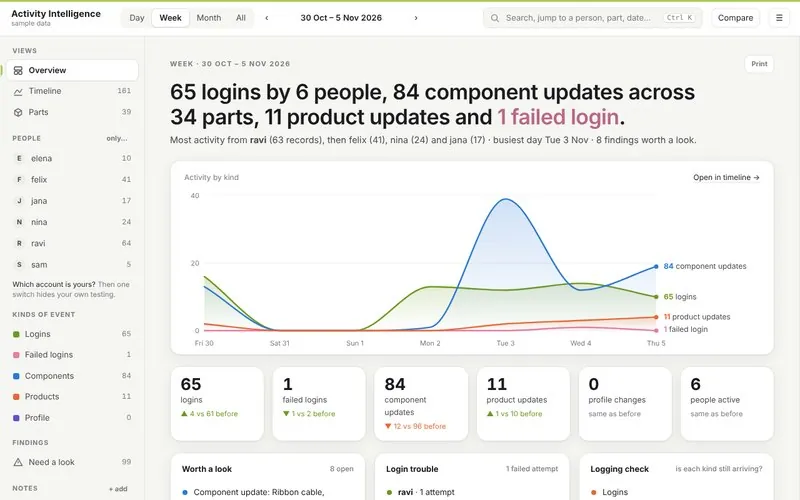
Who changed that stock count, and when?
Activity Intelligence Keeps watch on the inventory system: who has access to it, who did what and when, and the trail behind every change. It flags the things worth a look: password guessing, odd-hour logins, a stock count with an extra zero, and who might have broken something. Shown with six months of invented data.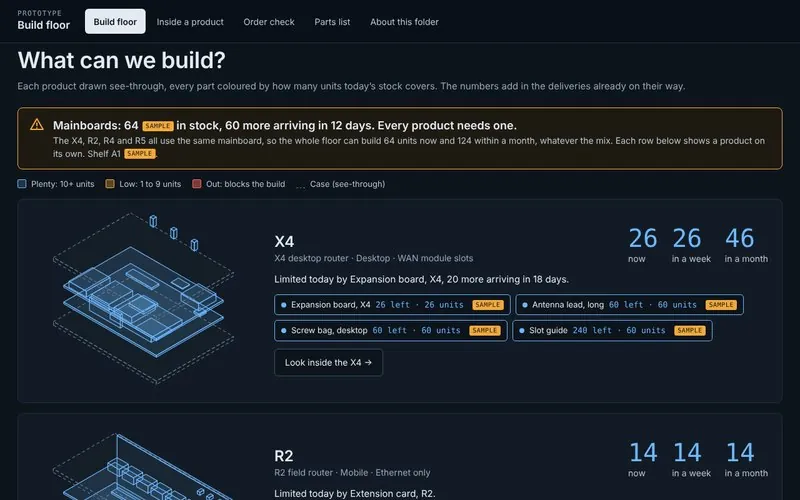
Can we build this order today?
Build floor The visual side, for sales and the bosses. It shows how many of each product can be built now, in a week and in a month, checks any order against the inventory system, and lists exactly which parts to order to hit the plan. Shown with sample stock and sketches; the drawings can be based on photos of the real products.
A factory floor working from scattered notes
Router Build Guide A photo-led, step-by-step assembly guide with quality checks, built from a real bench build. Short steps on screen, full detail when you need it. Private to the client, so shown on request.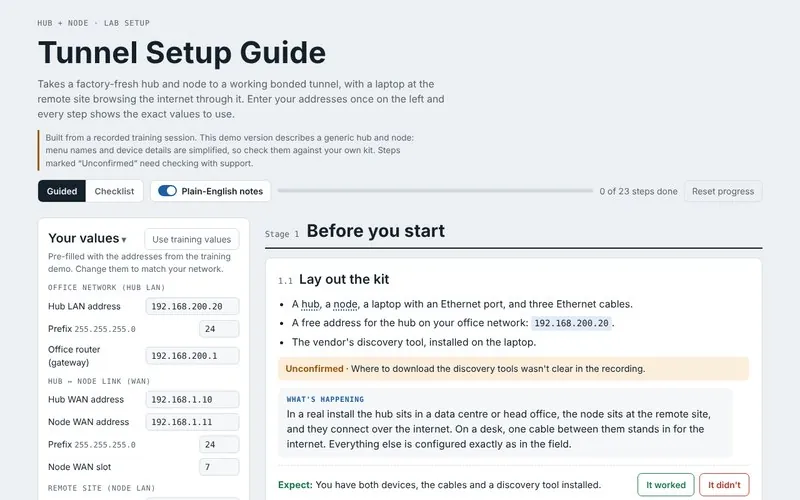
Customers forget what they learned in training
Tunnel Setup Guide A training session turned into a plain-English walkthrough of hub-and-node tunnel setup, with your own addresses filled in and troubleshooting at every step.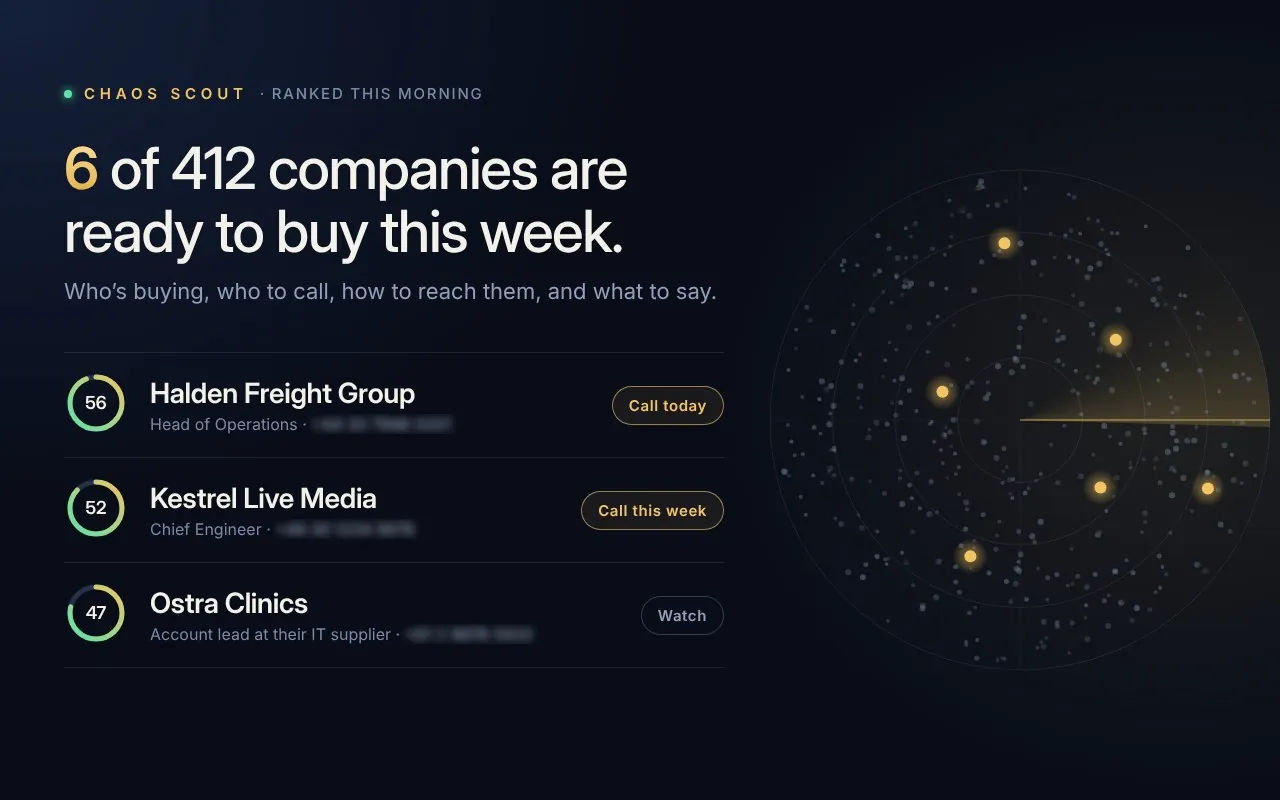
Sales teams waste time on cold lists
Chaos Scout Finds the companies most likely to need what you sell, then tells you who to call, how to reach them and what to say. It works from public signals and your own customer data, so there's no public demo; the picture uses invented companies.Whacky Weather is the most mature of the things I make for myself.
How many languages does a market speak?
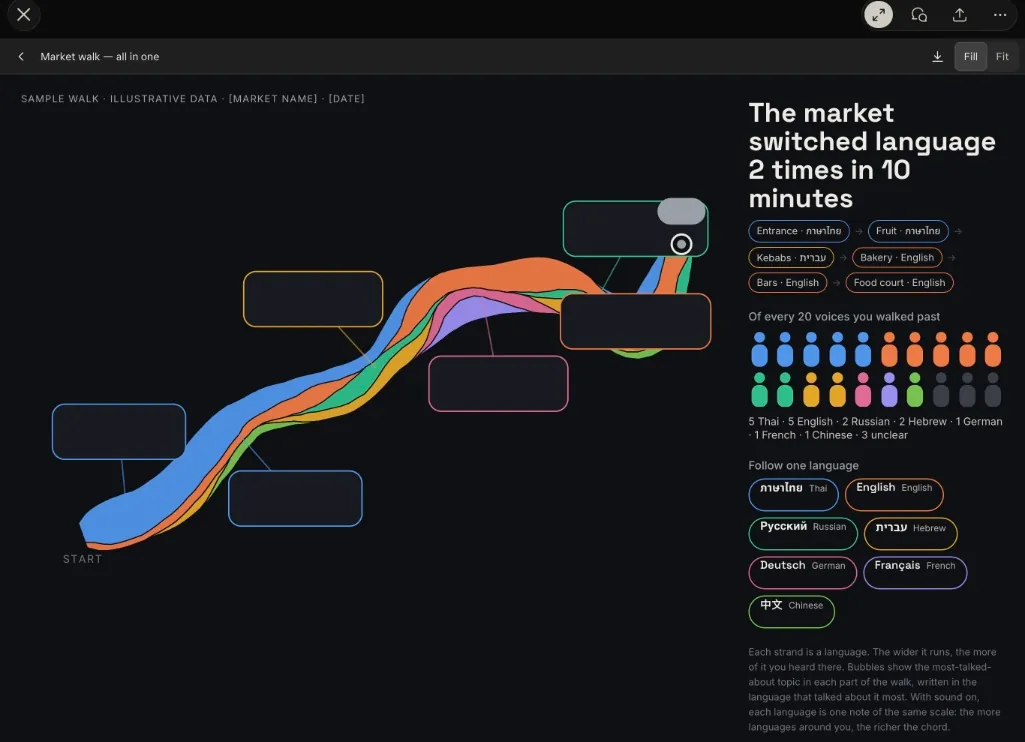
Market Language Census Walk a market for ten minutes and see which languages you hear, in what proportions and where along the route, drawn as a river of voices. Language detection runs on my laptop; no transcripts or raw sentences are shown. This preview uses sample data; the first real walk is still to come.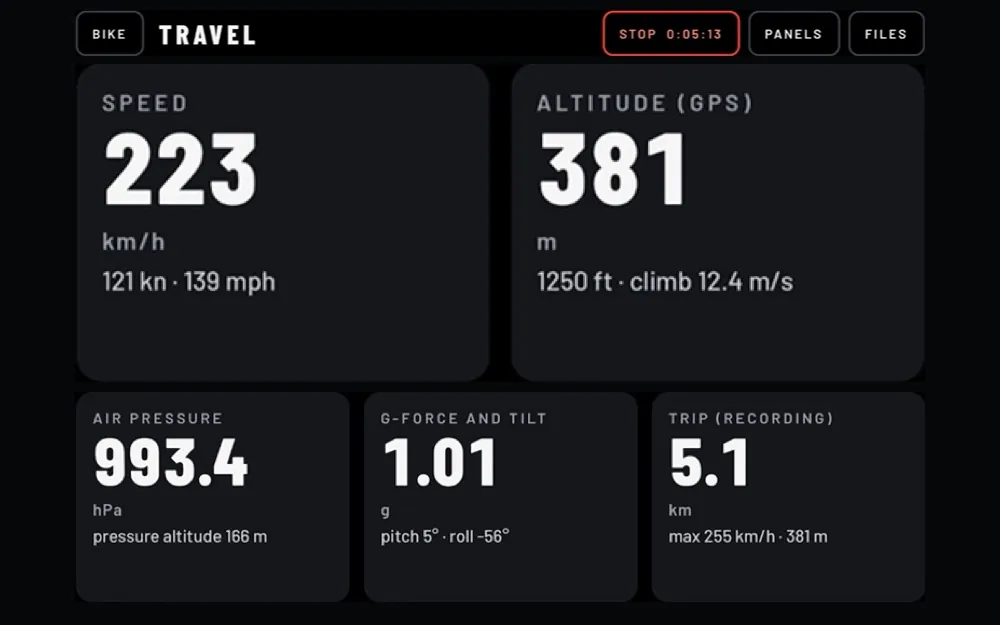
The fuel gauge on my scooter doesn’t work.
Whacky Speedo I built a phone speedometer for my Honda PCX that counts the distance since I last filled up and warns me before I run dry. A separate Fun mode logs flights, trains and ferries.
Three games at one table.
Whacky Poker Texas Hold’em against computer players, Ultimate Hold’em and Video Poker. Play with a virtual bankroll and work through challenges.An animated, interactive explainer for your website and sales calls, with short clips for LinkedIn and other social channels.
from €1,500
Hosted and updated for you, this lead finder ranks companies likely to need what you sell and shows who to contact, how to reach them and what to say. It draws on my years of research as a journalist.
from €2,500 + €200/month
A launch set in your voice: datasheet, solution brief, product page, launch article, one explainer and social clips.
from €3,500
All prices in EUR, excluding VAT.
Two half-days of my time, usually within a week. We talk through what you need, I spend half a day building a first version, you send notes, and I spend another half day on the changes. You keep what I've made, and we both decide whether to carry on. On a bigger job, it's one working part of it or a short plan for the whole thing.
Start a briefEvery project gets a fixed price once we've agreed the brief. Want something new every week or month? We'll agree a monthly price.
I also write (articles, case studies, bylines, ghostwritten blogs for executives, website copy) and make customer testimonial videos. Tell me what you need.
What you need, what it should achieve and what it has to fit into. Use my brief, write your own, have your AI write it, or just call. I like a human in the loop, but you don't have to book a meeting to get started.
Anywhere from a day to a week, depending on how complex it is and how many versions it takes. You see something real early, not a slide about something real.
Put it in front of the people who'll use it, whether that's customers, your sales team or the warehouse, and tell me what works and what doesn't. We refine it together until it does the job. Then it goes where it belongs: on your website, in your sales calls, or on your internal network, with no internet connection if that's what you need.
I build tools that fit into your system, not beside it.
Yes, and I use it too. The hard part isn't making something; it's knowing what to show, what to leave out, and when it's wrong. That's thirty years of asking engineers to explain things until a business person could follow. You tell me what you need; I bring the judgement and tools to make a thoughtful first version, then we test and refine it together.
Wherever you need it. Explainers and demos are single web pages that drop into WordPress, HubSpot, Webflow or any site that can embed a page, or I host them for you. Internal tools run on your own network or servers, with no internet connection needed. Either way, it's built around the systems you already have.
Internal tools run on your own network with no internet connection, so your data stays where it is and nothing calls out. Public pieces carry no ads, trackers, third-party scripts or outside fonts unless you ask for them. You get every file, so your IT team can check exactly what's in them and put them through your usual security review before anything goes live.
Plain HTML, CSS and JavaScript, with no framework, no build step and nothing loaded from anyone else's servers, not even fonts. Your IT team gets the source to review.
A brief: what it's for, who it's for and what it has to fit into. Then whatever you already have, such as product details, sample data and brand guidelines. If I need anything else, I'll ask.
You do, once it's paid for: the files, your branding and the right to change them however you like. The exception is a service I run for you, like the lead finder, which you license rather than buy.
Small fixes are quick and priced by the job. If your product or prices change often, we agree a monthly price and I keep everything up to date.
In your currency: euros, pounds, and US, Canadian and Australian dollars, among others, by ordinary local bank transfer or credit card. First projects are paid up front, by card if that's easiest. Bigger projects are half to start and half on delivery. If your company pays on 30-day terms against a purchase order, that's fine too.
Not unless you ask. There are no cookies by default. If you want leads, it can send them straight to your CRM.
I'm based in South-East Asia and work with teams in Europe, the UK, the Middle East, North America, Asia and Australia. I travel extensively, so I'm often in or near your time zone, and happy to meet in person if I'm passing through. Most of the work happens by email and shared files, and when we need to talk, we jump on a video call at a time that suits you.
Send me a brief: three questions, and your team or your AI can fill it in. Or just email me.
hello@whackyweather.cloud · Open to fixed-term contracts too.